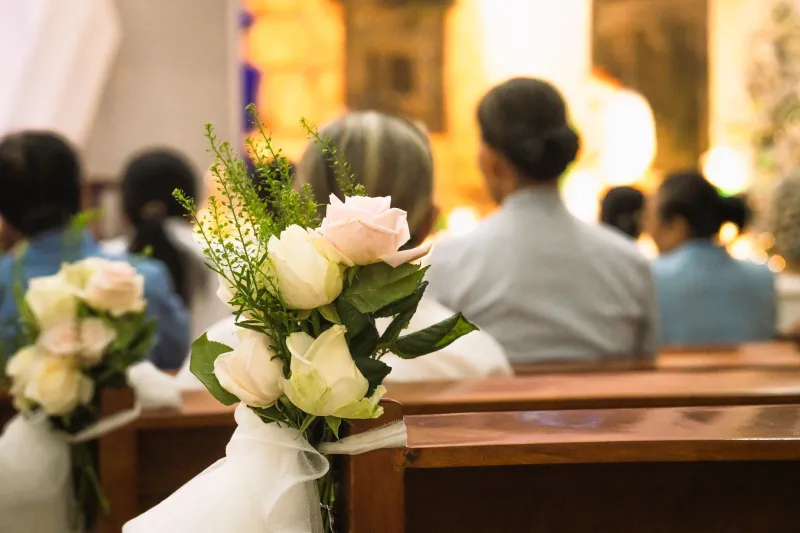
Garlands, Glasses and a Shared Aisle: Flower Planning for Leicester's Two-Ceremony Weddings
Photo: Milton Martínez / Secretaría de Cultura CDMX, Public domain, via Wikimedia Commons
Leicester weddings often come with two heartbeats: a ceremony full of colour, garlands and family ritual, then a British-style celebration with readings, confetti and a room that needs to feel like yours. Sometimes it's the other way round. Sometimes there are three events and a lunch in between. The flowers have to hold all of that together without looking like two separate weddings that happened to book the same florist.
The good news is that you don't need two completely different flower schemes. You need one clear idea, a sensible list of stems that can cope with a long day, and a plan for moving things between rooms without a meltdown. Here's how to make it work in Leicester venues, from a Belgrave hall to a city-centre hotel and a village church in between.
Start with a visual thread, not a theme
Mixed-ceremony flowers go wrong when couples try to tick every box. A marigold here, a lavender there, a bit of tartan ribbon because someone's Scottish aunt is coming. It becomes a mood board with no pulse.
Instead, pick one visual thread that belongs to both parts of the day. It might be a colour, a shape, or a texture. For an autumn wedding, marigold orange can sit beautifully next to copper-toned dahlias, burgundy chrysanthemums and deep green foliage. For a summer celebration, jasmine white can lead into soft British whites and creams, with scabious and nigella adding the kind of loose, airy texture that photographs well in grey light. The point is conversation, not matchy-matchy. The South Asian ceremony can be rich and saturated; the British ceremony can be softer. Shared greenery and a repeated flower shape will make them feel related.
If you're working with a mandap, a church altar and a reception room, choose two hero colours and one neutral. Three is plenty. More than that and the budget starts to leak.
The stems that earn their place
Marigolds are not a cliché. They are reliable, cheerful and they hold up in warm rooms better than many delicate blooms. They also bring a specific cultural weight, so use them with intent rather than as decoration sprinkles. Jasmine is gorgeous and fragrant, but it is thirsty and fragile. Plan for it to be conditioned properly, kept out of direct sun and checked during the day. Tuberose is another strong scent choice, though it can be overpowering near food or older guests, so keep it zoned.
For the British side of the day, look at what is genuinely good in the UK season. Dahlias from late summer into autumn, scabious, nigella, cornflowers, roses, chrysanthemums and plenty of British foliage. These stems don't try to compete with marigolds; they give the scheme somewhere to rest. If you want a flower that bridges both ceremonies, roses do a lot of quiet work. So do carnations, which have shaken off their bad reputation and last brilliantly in buttonholes and table posies.
Ask your florist which stems will be at their best in the week of your wedding. A good Leicester florist will be honest about what is struggling and what is plentiful. That conversation saves more money than any online discount code.
Heat, scent and the long middle of the day
Leicester summers are not reliably tropical, but marquees, mandaps and hotel ballrooms can get warm. Flowers that look fresh at 9am can look tired by the time speeches start. Build in a check-in. If jasmine is part of your plan, keep it in water for as long as possible and avoid wiring it hours before it needs to be worn. Marigold garlands are better made close to the ceremony than the day before. If your venue has a cool room or a shaded corridor, use it as a holding area.
Scent needs a map. Jasmine and tuberose near the entrance and around the ceremony space can be beautiful. The same flowers next to a curry buffet or a cheese table become a problem. Keep heavily scented arrangements away from food, and ask about allergies before you fill a small room with lilies or strong stocks.
Two rooms, one order
This is where the budget is won or lost. You do not need a full second set of flowers for the reception. You need a plan for what can move and what should stay put. Ceremony posies can become bar arrangements. A garland used as a backdrop can sometimes move to a photo area, but check with your officiant and family first. Anything used in a religious ceremony should be handled with respect, not repurposed like a prop. A separate decorative garland for the reception is often the kinder choice.
Think about labour as well as stems. Garlands are beautiful but they are time-heavy. If your budget is tight, use partial garlands, foliage-heavy arrangements and a few statement pieces rather than covering every surface. Put money into the places guests actually look: the entrance, the ceremony focal point, the top table and the bar. The toilets can have a single stem in a jam jar and still feel considered.
A realistic budget split
For a two-ceremony day, start with a 60/40 split rather than 50/50. The ceremony where you stand in front of everyone usually deserves the stronger visual moment. The reception can lean on candlelight, greenery and reused pieces. Add a 10% contingency for delivery between venues, extra labour and the inevitable last-minute stem change.
If you are getting married in 2026 and juggling two venues, write down the delivery times before you fall in love with a flower. Leicester traffic on a Saturday is its own ceremony. A flower captain, usually a friend with a clipboard and a cool head, is worth more than an extra centrepiece.
Let both ceremonies look like you
Mixed-ceremony weddings are not a trend to be styled. They are family, faith, compromise and celebration. The flowers should reflect that without turning either ceremony into a costume. Ask questions. Find out what matters to parents and grandparents. Find out what the officiant will allow. Then choose flowers that can carry the colour, the scent and the meaning across both rooms without shouting over either one.
Done well, nobody will say the flowers looked South Asian here and British there. They will say the whole day felt like one wedding. That is the goal.